Information Centre
Fabric Light Box Buyer’s Guide: Everything You Need to Know
Choosing the right fabric light box involves more than selecting a size. Frame depth, illumination type, graphics, installation requirements and customisation can all affect how the finished display performs.
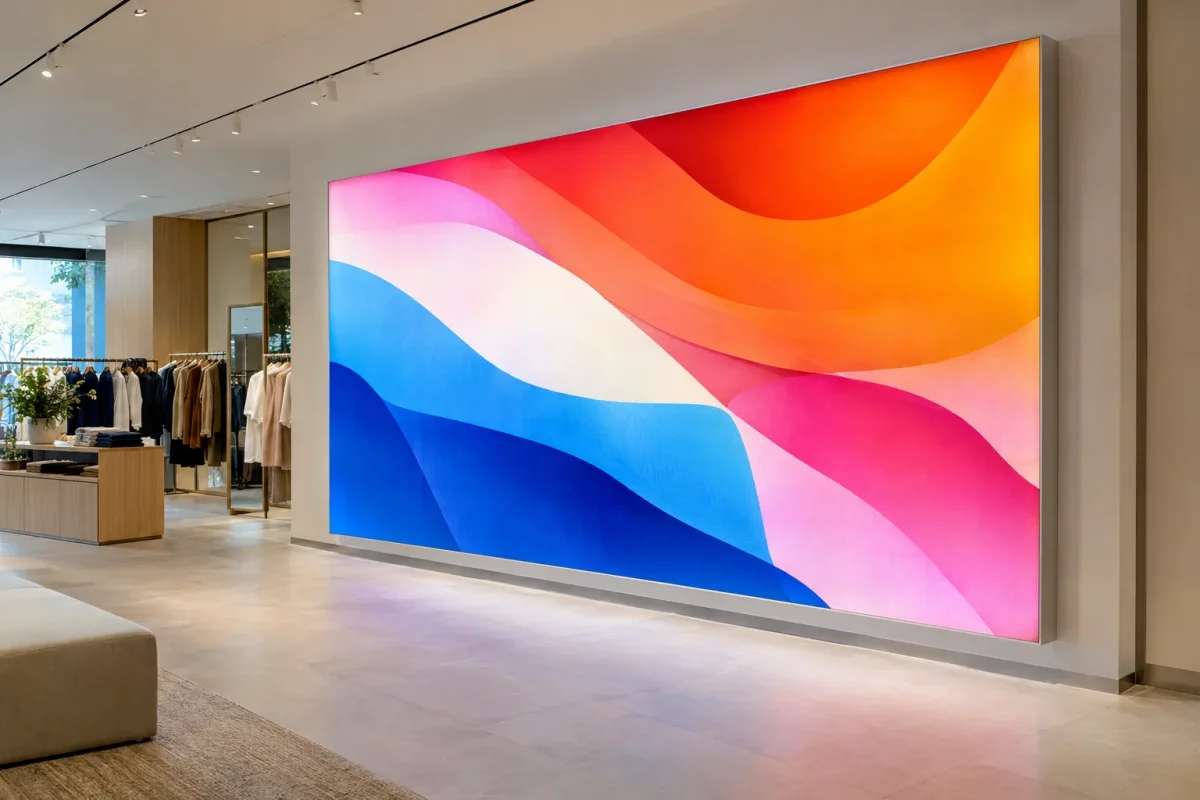
This guide explains the key factors commercial buyers should compare before requesting a quote.
It covers frame depth options, illumination types, standard and custom sizing, fabric graphics, installation requirements, pricing context and the key questions to ask before placing an order. Whether you are specifying a single-site retail display or planning a multi-location rollout across Australia, this guide will help you identify the right solution before you request a quote.
Key takeaways
- A fabric light box is an illuminated display frame that uses LED lighting to backlight or edge-light a printed stretch fabric graphic.
- Edge-lit systems suit small to medium format displays, while backlit configurations are the preferred choice for large-format displays and high-visibility commercial environments.
- Custom frames are manufactured to the exact dimensions provided, so accuracy in specifying measurements is critical.
- Many fabric light box graphics can be replaced without specialist tools, although larger installations may require more than one person for safe handling.
- Every fabric light box requires a power connection, and the cable entry point must be planned in advance.
- Standard fabric light boxes are designed for indoor commercial use.
- Pricing is confirmed at the time of enquiry to ensure accuracy across configurations.
What Is a Fabric Light Box?
A fabric light box is an illuminated display frame that uses LED lighting to backlight or edge-light a printed stretch fabric graphic, producing a vivid, evenly lit visual display with a clean, premium finish. The system consists of three components working together: an aluminium extrusion frame that houses integrated LED strip lighting, and a Silicone Edge Graphic (SEG) fabric panel that clips into a channel running around the inside of the frame.
The LED lighting behind or around the fabric illuminates the printed image from within, producing significantly better visibility than non-illuminated signage, particularly in retail, hospitality and high-traffic commercial environments.
Fabric light boxes are used commercially because they combine high-visibility illumination with the flexibility to swap graphics quickly without replacing the frame, making them a cost-effective long-term display asset.
Frame Depth Options: Which Thickness Is Right for Your Application?
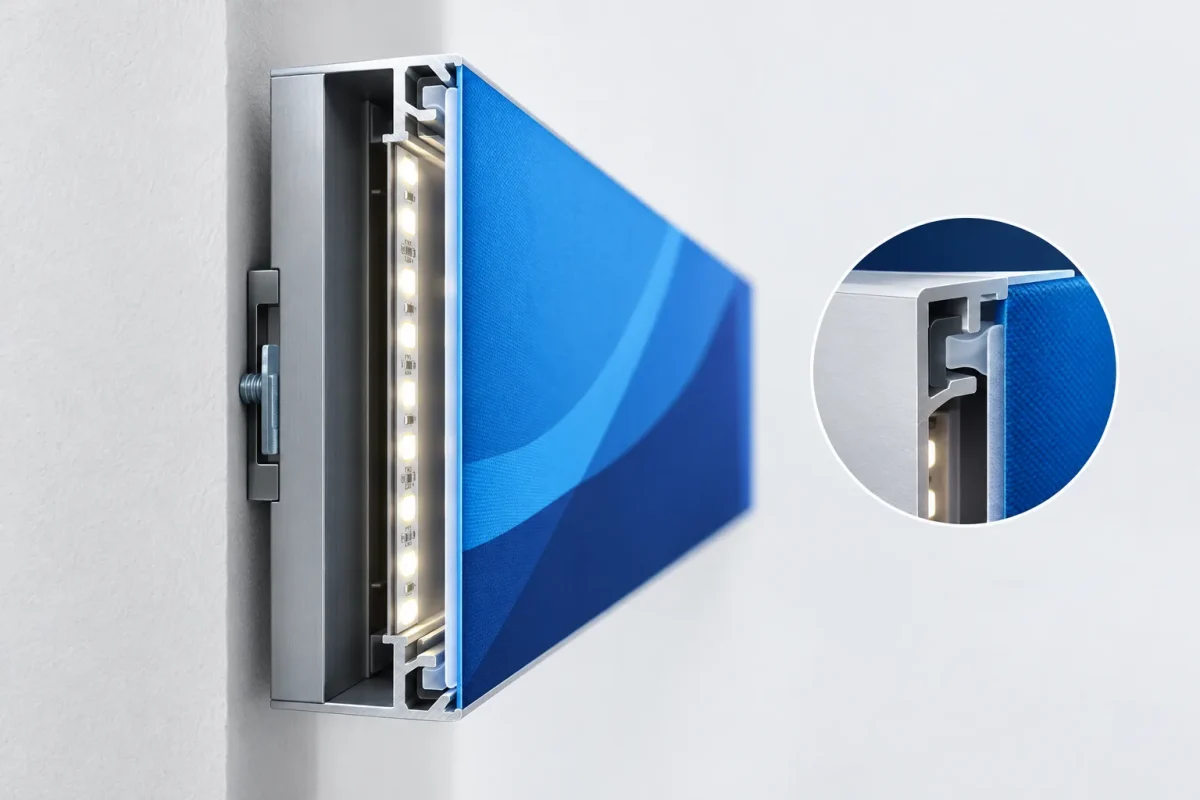
Fabric light boxes are available in different frame depths to suit various display requirements. Common extrusion sizes include 33mm, 60mm, 90mm and 180mm, with 180mm typically used for double-sided illuminated displays. The frame depth influences how far the light box extends from the wall, how evenly light is distributed across the graphic and its suitability for different installation environments.
50mm Slim Frame
A 50mm frame is best suited to wall-flush applications where minimal protrusion is required. This depth is commonly specified for retail window displays, internal wall signage in corridors or reception areas, and any installation where space constraints limit how far a frame can extend from the surface.
At 50mm, edge-lit configurations perform well for small to medium panel sizes. On very large panels, slight brightness variation from edge to centre is more noticeable at this depth, which is worth considering before specifying a slim frame for a wide-format display.
80mm Standard Frame
The 80mm frame is the most widely used depth for general commercial applications in Australia. It balances LED coverage, brightness uniformity and frame profile effectively, making it appropriate for retail floor displays, hospitality signage, exhibition panels and most standard fit-out applications.
If you are unsure which depth to specify and your application does not have specific space restrictions or extreme brightness requirements, an 80mm frame can be a useful starting point, subject to the display size, illumination requirements and installation conditions.
100mm to 125mm Deep Frame
A 100mm to 125mm frame depth is recommended for large-format displays, double-sided configurations, or environments where ambient light is high and maximum brightness output is required. Greater frame depth allows more LED modules to be incorporated and gives light a longer diffusion distance before reaching the fabric surface, which improves uniformity across wide panels.
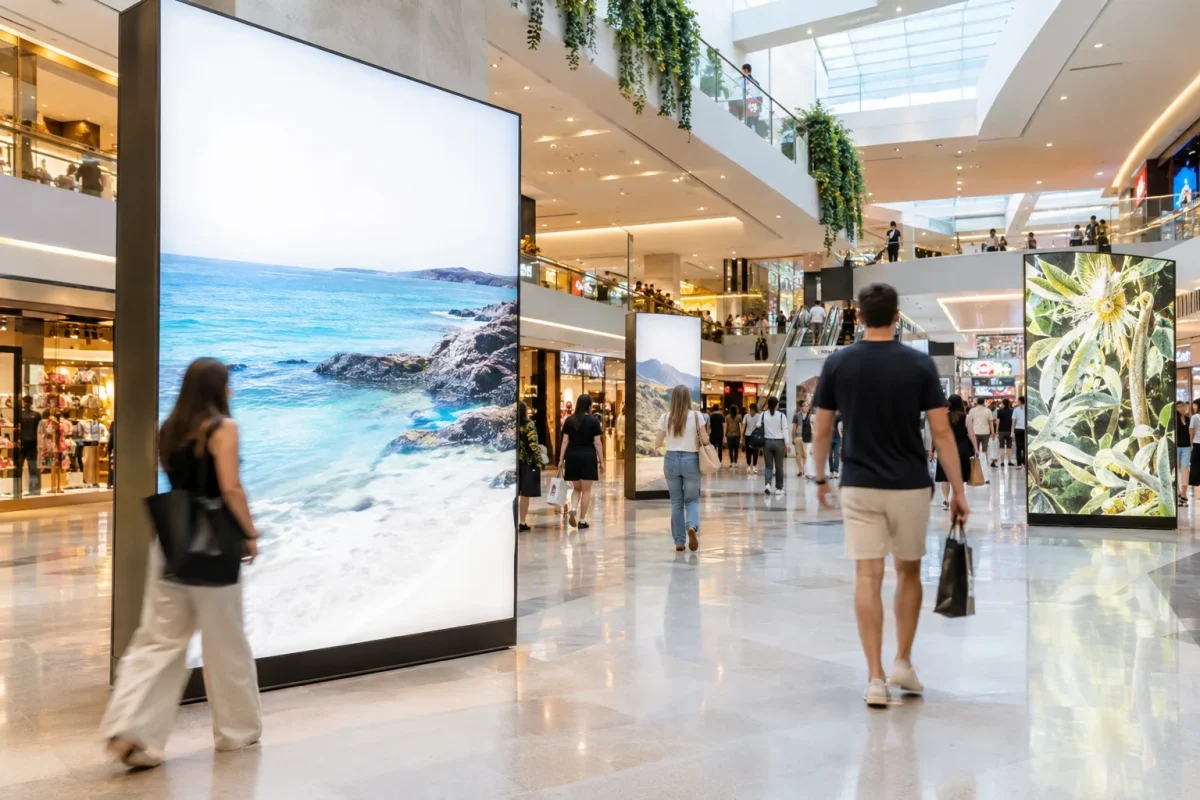
This depth is commonly specified for large retail environments, shopping centre atriums, transport hubs, showroom feature walls and any backlit larger-format backlit applications where increased frame depth helps maintain more even illumination.
| Frame Depth | Typical Application | Brightness Level | Protrusion from Wall |
|---|---|---|---|
| 50mm | Window displays, slim wall signage | Moderate | Minimal |
| 80mm | Retail, hospitality, exhibitions | High | Standard |
| 100mm to 125mm | Large format, high-brightness environments | Very High | Visible |
Frame depth depends on three factors: wall recess depth, power access constraints, and the brightness output required for the ambient light conditions of the installation environment.
Edge-Lit vs Backlit Fabric Light Boxes: What Is the Difference?
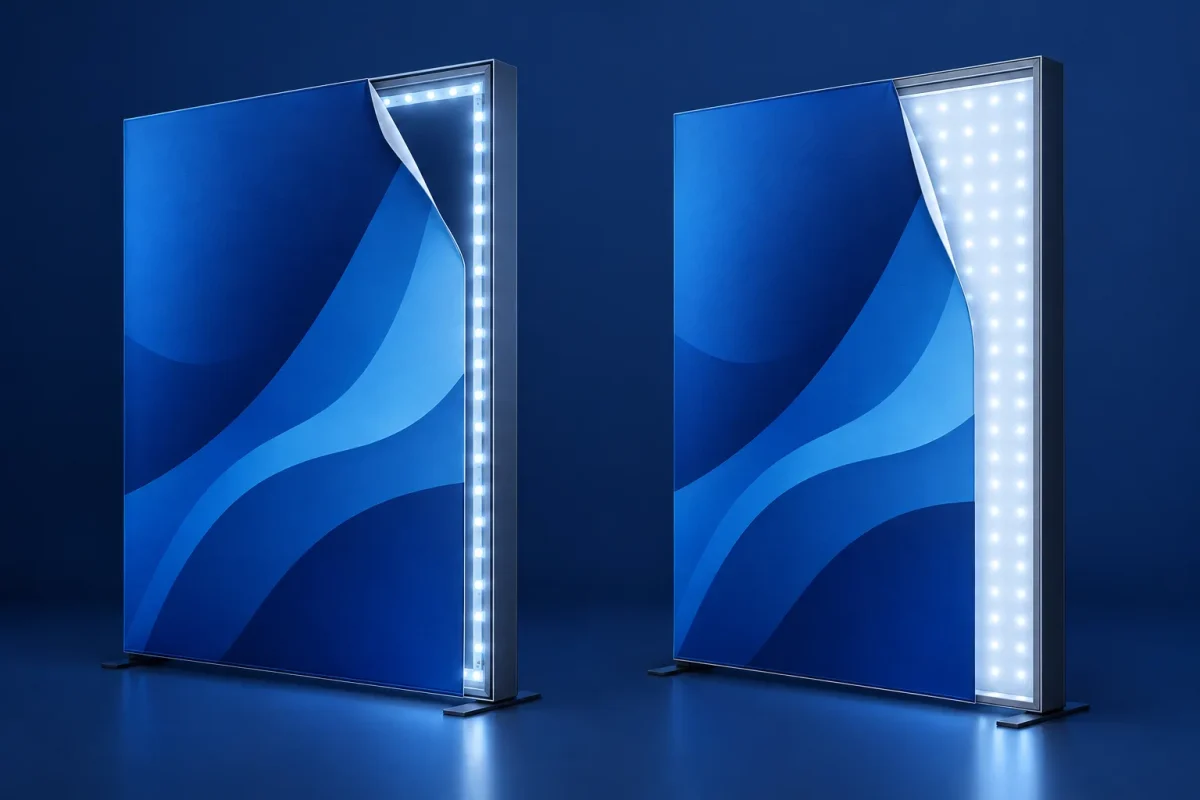
Edge-lit fabric light boxes differ from backlit models in that the LEDs are positioned along the frame edges and light is dispersed inward across the fabric surface, whereas backlit models distribute LEDs across the full rear panel to illuminate the graphic from directly behind. This distinction has practical implications for brightness uniformity, maximum panel size and frame depth requirements.
Edge-Lit Fabric Light Boxes
In an edge-lit configuration, LED strips run along one or more edges of the aluminium frame. Light travels across the depth of the frame and is diffused through the fabric. This approach allows for a slimmer frame profile and works well for small to medium format displays where uniform illumination is achievable within the panel dimensions. Edge-lit systems are a practical and cost-effective choice for retail window displays, internal signage, exhibition panels and applications where a lower frame profile is a priority.
Backlit Fabric Light Boxes
In a backlit configuration, LEDs are distributed across the full back panel of the frame, providing consistent, uniform illumination across the entire graphic surface regardless of panel size. This makes backlit systems the preferred choice for large-format displays, graphics with significant variation in tone across the surface, and high-visibility commercial environments such as shopping centres, showrooms and branded feature walls.
Backlit configurations typically require greater frame depth to accommodate the rear LED array, which is why 100mm to 125mm depths are more commonly associated with backlit applications. The trade-off in wall protrusion is generally justified by the improvement in illumination quality on large panels.
| Factor | Edge-Lit | Backlit |
|---|---|---|
| LED position | Frame edges | Full rear panel |
| Frame depth required | 50mm to 80mm | 80mm to 125mm |
| Brightness uniformity | Good for small to medium panels | Suitable for a broad range of sizes, particularly larger formats |
| Best panel size | Up to approximately 1500mm shortest dimension | Any size, preferred for large format |
| Typical applications | Window displays, exhibitions, internal signage | Retail feature walls, showrooms, transport hubs |
| Wall protrusion | Minimal to standard | Standard to visible |
For most large commercial applications in Australia, backlit configurations deliver more consistent results. For smaller or space-constrained installations, edge-lit systems offer a capable and cost-efficient solution.
Standard Sizes and Custom Sizing Options
Fabric light boxes are available in standard sizes and can also be manufactured to fully custom dimensions to suit architectural specifications and non-standard wall configurations.
Custom sizing is available from most reputable commercial suppliers and is standard practice for architectural fit-outs, recessed wall applications, shopfit integrations and any project where the display must conform to specific wall dimensions or design specifications. Custom frames are manufactured to the exact dimensions provided, so accuracy in specifying measurements is critical. Any error in the stated dimensions will flow through to both the frame and the printed fabric graphic.
A few considerations for custom sizing:
- Custom frames typically carry longer lead times than standard sizes. Confirm these with your supplier before locking in an installation schedule.
- Some suppliers apply minimum order quantities to custom configurations, particularly for smaller-scale single-unit requests.
- Graphics are printed to match the frame dimensions precisely. File specifications and sizing must be confirmed with your supplier before artwork is produced to avoid reprinting costs.
- Standard frames can often be combined as a modular system to cover large wall areas. This can be a cost-effective alternative to a single very large custom frame and may simplify installation and future graphic replacement.
If your project has a defined installation date and a standard size fits the space, that is generally the faster and lower-cost path. If the wall area, architectural design or branding specifications do not align with standard dimensions, custom sizing is the appropriate choice and most commercial suppliers will accommodate it as a matter of course.
Fabric Graphics: Materials, Printing and Replacement
What Type of Fabric Is Used?
Silicone Edge Graphic (SEG) fabric is the standard for commercial fabric light box displays. It is a stretch polyester fabric with a silicone bead bonded around the perimeter. The bead sits inside the extrusion channel on the frame and holds the fabric under consistent tension, eliminating creases and producing a smooth, professional graphic surface.
Graphics are printed using dye-sublimation, a printing process that bonds colour into the fabric fibres rather than sitting on the surface. Dye-sublimation delivers accurate colour reproduction, smooth gradients and excellent backlit clarity, which is essential when the graphic is illuminated from behind or around the edges.
How Are Graphics Replaced?
Many fabric light box graphics can be replaced without specialist tools, although larger installations may require more than one person for safe handling. This makes them well-suited to retail environments, hospitality venues and marketing teams that update displays regularly for campaigns, seasonal changes or promotional cycles.
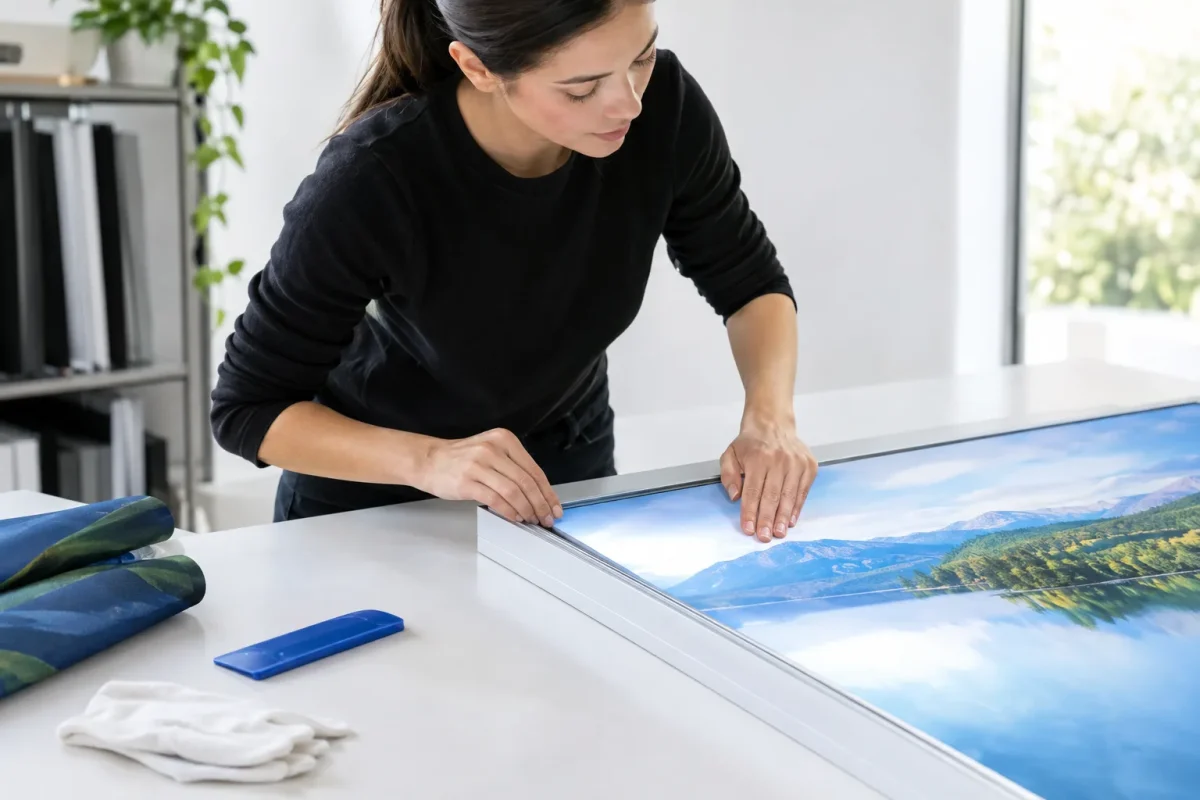
The graphic replacement process for a standard fabric light box is as follows:
- Power down the light box before handling the graphic panel.
- Open or remove the front frame section, depending on the frame design (some frames use a snap-open front, others require the graphic to be accessed from the edge).
- Starting at one corner, pull the silicone bead of the existing graphic out of the extrusion channel and continue around the full perimeter to remove the fabric.
- Position the new SEG fabric over the frame opening and insert the silicone bead into the channel at the corners first to establish alignment.
- Work around the perimeter, pressing the bead firmly into the channel, keeping tension even across the fabric surface as you go.
- Check the graphic for even tension and smooth appearance before powering the light box back on.
Replacement graphics are usually supplied rolled or folded, and the silicone bead reseats cleanly into the channel without adhesives or fixings. A full graphic swap on a standard retail-size panel typically takes less than fifteen minutes once the operative is familiar with the process.
Graphic Lead Times and File Requirements
Print-ready artwork is typically supplied as a high-resolution PDF or TIFF file at the correct output dimensions and colour profile. Your supplier will provide a specific artwork specification sheet that details bleed, safe zones, resolution requirements and colour mode before production begins.
Graphic reprint turnaround times in Australia vary by supplier and print volume, but buyers should plan for a minimum of five to ten business days for standard reprints and longer for large-format or complex jobs. Confirm lead times directly with your supplier when planning campaign schedules.
Common Commercial Applications for Fabric Light Boxes
Fabric light boxes are suited to any commercial environment where high-visibility, professionally finished illuminated signage is required. They are particularly well established in the following settings:
- Retail stores: Window displays, feature walls, promotional bays, end-of-aisle displays and seasonal campaign panels.
- Hospitality venues: Lobby and entrance signage, menu and promotional displays, branded environment installations and bar or reception feature walls.
- Corporate offices: Reception and foyer signage, meeting room branding, wayfinding panels and branded environment installations.
- Showrooms: Product feature displays, brand walls, demonstration zones and premium-finish architectural signage.
- Exhibitions and trade shows: Portable backwall displays, booth branding, modular panel systems and free-standing banner alternatives.
- Shopping centres and transport hubs: High-traffic promotional displays, tenant signage, directional and wayfinding graphics in high-ambient-light environments.
- Healthcare and education: Wayfinding systems, branded environments, donor recognition walls and public-facing information displays.
The consistent factor across these applications is the need for illuminated visibility that exceeds standard printed signage, combined with the practical ability to update graphics without replacing the display structure.
Installation Considerations for Commercial Environments
Installation requirements for fabric light boxes vary depending on frame size, mounting method and the characteristics of the installation environment. Reviewing these requirements with your supplier before ordering will prevent delays and avoid unexpected costs on site.
Mounting options include direct wall mounting, freestanding floor systems, suspended ceiling installations and integration into shopfit joinery or recessed wall apertures. Each has different structural and power access requirements.
Power supply routing is one of the most important pre-installation considerations. Every fabric light box requires a power connection, and the cable entry point must be planned in advance, particularly for wall-mounted applications where cabling needs to run through or behind the wall surface. For recessed installations, conduit and cable routing should be factored into the shopfit or building works before the frame is installed.
Installation requirements depend on the frame size, mounting surface and access conditions. Larger or more complex systems may require an experienced installer or shopfitter. Larger format frames, suspended ceiling installations or systems being integrated into architectural joinery are more involved and typically require a qualified shopfitter or installer with appropriate access equipment.
Fixing methods include direct screw fixing to wall studs or substrate, reveal or shadow-line fixing for a flush-finish edge, and integration into joinery panels or freestanding base systems. The fixing method affects the finished appearance of the installation and should be selected in consultation with your supplier or shopfitter during the planning stage.
Outdoor applications are not typically suited to standard fabric light box systems, which are designed for indoor commercial environments. If outdoor illuminated signage is required, consult your supplier about weatherproof or outdoor-rated alternatives.
How Much Does a Fabric Light Box Cost in Australia?
The cost of a fabric light box in Australia varies depending on frame size, depth, quantity and whether the fabric graphic is included, but buyers should contact Snapper Display Systems directly for current pricing across the standard and custom range. Pricing is confirmed at the time of enquiry to ensure accuracy across configurations.
The following factors have the most significant influence on the final cost of a fabric light box installation:
- Frame size: Larger frames require more extrusion material, more LED modules and larger fabric graphics, all of which increase cost proportionally.
- Frame depth: Deeper frames with backlit LED configurations carry a higher material cost than slim edge-lit options.
- Standard versus custom sizing: Custom frames may involve additional manufacturing requirements and longer lead times compared with standard configurations.
- Single-sided versus double-sided: Double-sided frames for freestanding or suspended applications are priced higher than single-sided wall-mounted units.
- Graphic printing: Whether fabric graphics are included in the quoted price or supplied separately will affect the total cost. Confirm this when comparing supplier quotes.
- Quantity: If you are planning a rollout across multiple locations, enquire about volume pricing from the outset.
- Installation: Professional installation costs vary by location, frame size and mounting complexity, and are typically quoted separately from the display system itself.
Standard vs Custom Fabric Light Boxes: Which Should You Choose?
| Consideration | Standard | Custom |
|---|---|---|
| Lead time | Shorter | Longer |
| Unit cost | Lower | Higher |
| Size flexibility | Limited to set dimensions | Any dimension |
| Minimum order | Often no minimum | May apply |
| Graphic accuracy | Pre-determined to frame size | Specified to exact dimensions |
| Best for | Single sites, tight timelines, budget-conscious projects | Architectural fit-outs, multi-site rollouts, non-standard spaces |
Standard sizes are the right choice when the wall space accommodates a set dimension, the timeline is tight, or the project budget requires a lower entry cost. Custom sizes are appropriate when the installation environment demands specific dimensions, the display is being integrated into shopfit joinery or a recessed aperture, or the design specification requires a precise format that standard sizes cannot deliver.
For multi-site rollouts, it is worth considering whether a custom size that fits all locations consistently is more efficient than adapting standard sizes site by site. A single consistent specification across multiple locations simplifies graphic production, stock management and future replacements.
Key Factors to Consider Before Buying a Fabric Light Box
Buyers who review these considerations before requesting a quote are better placed to specify the right product, avoid costly amendments and receive an accurate price the first time.
- Frame depth and wall protrusion: Does the frame depth suit your available wall space? If the display is being recessed, does the recess depth match the frame specification?
- Illumination type: Is an edge-lit configuration adequate for your panel size and ambient light conditions, or does the application require the uniform brightness of a backlit system?
- Size requirements: Will a standard size accommodate your wall space and design intent, or do you need custom dimensions to fit the environment accurately?
- Graphic replacement frequency: How often will the display graphic be updated? If campaigns change frequently, confirm that the frame design supports straightforward single-person graphic replacement.
- Power access: Is there a power source available at or near the installation point? Has cable routing been planned into the wall or joinery construction?
- Single-sided or double-sided: Will the display be viewed from one direction only, or does it need to present a graphic on both faces?
- Indoor or outdoor environment: Confirm with your supplier if there is any element of outdoor exposure. Standard fabric light boxes are designed for indoor commercial use.
- Supplier capability: Can the supplier provide both the frame system and printed fabric graphics? Do they offer installation guidance, artwork specifications and replacement graphic services? These capabilities reduce the number of parties involved in your project and simplify ongoing management.
Choosing the Right Fabric Light Box Supplier in Australia
Beyond the product specifications, the supplier you work with will have a significant impact on how smoothly your project runs. Before placing an order, consider asking the following:
- What standard frame depths and sizes do you carry, and what is your lead time for each?
- Do you manufacture custom sizes, and what are the minimum order requirements?
- Do you provide fabric graphic printing, and what are the artwork file specifications?
- What is the LED lifespan rating for the light box range, and is it backed by a warranty?
- Can you provide installation guidance or connect us with recommended installers in our area?
- What is the process for ordering replacement graphics once the frame is installed?
- Do you offer volume pricing for multi-site or multi-unit orders?
FAQs
What is a fabric light box?
A fabric light box is an illuminated display system that uses LED lighting and a tensioned fabric graphic, typically SEG fabric, to create a bright, seamless visual display. They are commonly used in retail, hospitality, corporate, exhibition and other commercial environments.
What is the difference between edge-lit and backlit fabric light boxes?
Edge-lit light boxes position LEDs around the frame edges, which helps keep the profile slimmer. Backlit light boxes position LEDs across the rear panel, providing more uniform illumination and making them better suited to larger-format displays and high-visibility applications.
Can fabric light boxes be made to custom sizes?
Yes. Fabric light boxes can be manufactured to custom dimensions for architectural fit-outs, recessed walls, shopfit joinery and other applications where standard sizes do not suit the available space or design requirements.
How long do fabric light box graphics take to produce?
Lead times vary by supplier, artwork complexity and print volume. The guide recommends confirming production times directly with your supplier, particularly for large-format graphics or projects with fixed campaign or installation dates.
Are fabric light boxes suitable for outdoor use?
Standard fabric light box systems are generally designed for indoor commercial environments. If the display will be exposed to outdoor conditions, ask your supplier about weatherproof or outdoor-rated illuminated signage options.
Ready to request a quote?
Tell us about your display and we will confirm pricing for your configuration.